Advantages
Materials
Insurance Codes
Available ingots
Multi ingots
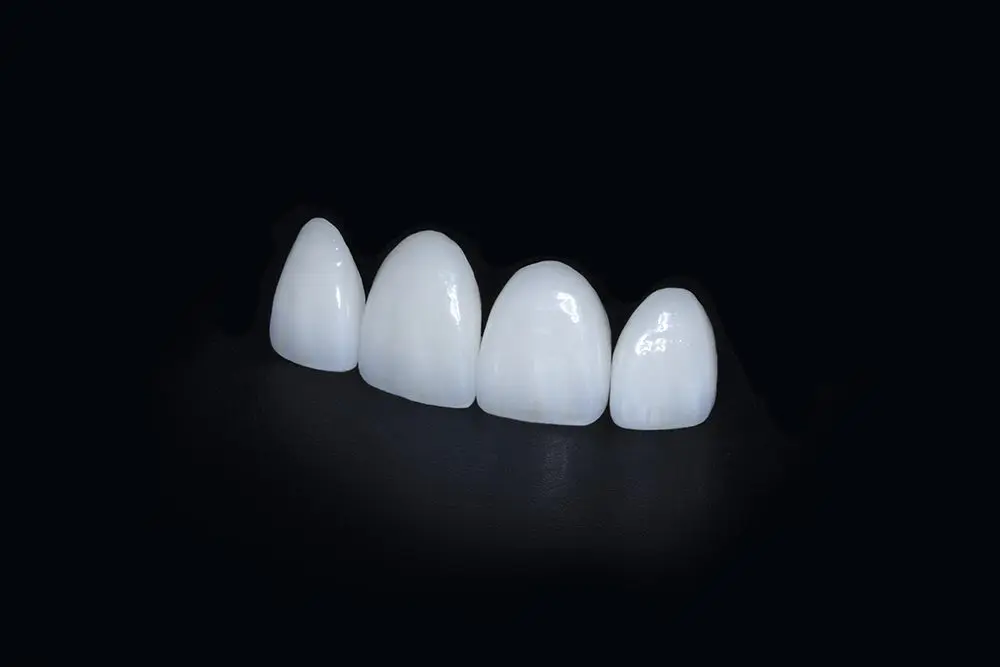
The innovative Multi ingots are available in selected Bleach BL and A–D shades. The material demonstrates a lifelike shade progression from the dentin to the incisal areas and therefore imparts monolithic restorations with a highly esthetic appearance. With these ingots, veneers and anterior, posterior and hybrid abutment crowns are fabricated quickly and efficiently. Ideally, these restorations only need to be glazed. If desired, however, they can be modified using the staining or cut-back technique.
HT ingots
The high translucency ingots (HT) are suitable for the fabrication of minimally invasive full-contour restorations, such as inlays, onlays, and veneers. The restorations are characterized by staining materials.
MT ingots
The MT ingots are provided in the following shades: A1, A2, A3, B1, BL2, BL3, and BL4. These medium-translucency ingots are used in cases where a brighter material than HT and a more translucent material than LT is needed. Restorations made of the MT ingots are ideal for the staining and cut-back techniques.
LT ingots
Full-contour partial crowns and crowns are fabricated with the low translucency ingots (LT). In the anterior region, in particular, the esthetic appearance of the restorations is maximized by employing the cut-back technique.
MO ingots
The medium opacity ingots (MO) are used to fabricate substructures for vital or slightly discolored teeth. They create an ideal basis for lifelike restorations completed with the layering technique.
HO ingots
In cases where the prepared tooth structure is discolored or titanium abutments are used, the HO ingots mask the dark background to achieve highly esthetic results.
Impulse ingots
The Impulse™ ingots are available in two different levels of brightness (Opal 1, Opal 2). The restorations produced with these ingots have exceptionally opalescent properties. Therefore, this material is ideal for producing (thin) veneers for light teeth, which require an opalescent effect.
Clinical Notes
Flexural strength of this material is approximately 400 megapascals. As you can see, this is about four times stronger than the porcelain on a PFM, yet only about a third of the strength of our Full-Contour Zirconia. Now, our Aesthetic Layered Zirconia, as I mentioned, is about 650, so a little less in the strength of our Aesthetic Layered Zirconia, which is our anterior monolithic or aesthetics monolithic zirconia and a third of that of our monolithic Full-Contour Zirconia.
Where I use veneers, anterior crowns, and that includes pre-molars, I consider a pre-molar to be an anterior too, and posterior crowns with adequate occlusal clearance and I would say a minimum of 1 mm occlusal clearance. As I mentioned earlier with the Full-Contour Zirconia or the Aesthetic Layered Zirconia, monolithic zirconia, we can go 0.5 mm. In some situations on second molars where the patient has a reduced inner arch distance, maybe a short clinical crown prep and we have minimal occlusal clearance, E-Max is contraindicated, in my opinion for that. That’s where a Full-Contour Zirconia or a Aesthetic Layered Zirconia is ideal.
The other application for E-Max is anterior three-unit bridges. The pontic width, maximum, is 11 mm in the anterior, so that’s single pontic, and 9 mm in the posterior. That is a pre-molar. I have no problem going a bridge from 27 to 29 or 20 to 22 with E-Max, but as soon as we go and we replace a molar where the pontic width is greater than 9 mm, we’re going to switch to either PFM or a zirconium, either a substructure or monolithic.